Por NuzaBy Nuza
«No eres lo que haces de vez en cuando, sino lo que haces todos los días.»"You are not what you do once in a while, but what you do every day."
Lo que haces en el tapete dura una hora; lo que haces el resto del día, veintitrés. Por eso la práctica de yoga no se mide solo por la clase: se sostiene —o se desperdicia— en cómo duermes, cómo comes, cómo descansas y cómo cuidas tu cuerpo cuando nadie te ve. Integrar es eso: que la calma y el cuidado del tapete se filtren al resto de tu vida.
What you do on the mat lasts an hour; what you do the rest of the day, twenty-three. That's why a yoga practice isn't measured by the class alone: it's sustained — or wasted — in how you sleep, how you eat, how you rest, and how you care for your body when no one is watching. That's what integrating means: letting the calm and care of the mat seep into the rest of your life.
Aquí no hay reglas rígidas ni fórmulas mágicas, pero sí cosas que la ciencia ha medido bastante bien. Estos son los hábitos que de verdad hacen la diferencia, con los datos que lo respaldan y explicados con calma para que elijas por dónde empezar.
There are no rigid rules or magic formulas here, but there are things science has measured quite well. These are the habits that truly make a difference, with the data that backs them up, explained calmly so you can choose where to begin.
El sueño: donde de verdad te recuperasSleep: where you truly recover
De todos los hábitos, este es el que más rinde — y el que más se descuida. Mientras duermes, sobre todo en el sueño profundo, el cuerpo libera la mayor parte de la hormona del crecimiento, la que repara músculo y tejido. Y el cerebro hace su propia limpieza: en 2013, un equipo de la Universidad de Rochester descubrió que durante el sueño se abre un sistema de drenaje —el sistema glinfático— que arrastra los desechos que se acumulan en el cerebro durante el día (Xie et al., 2013).
Of all the habits, this is the one that pays off the most — and the one most neglected. While you sleep, especially in deep sleep, the body releases most of its growth hormone, the one that repairs muscle and tissue. And the brain does its own cleaning: in 2013, a team at the University of Rochester discovered that during sleep a drainage system opens up — the glymphatic system — that clears away the waste that builds up in the brain during the day (Xie et al., 2013).
Eso se nota, y mucho, en el cuerpo. Cuando investigadores de Stanford pidieron a jugadores universitarios de basquetbol que durmieran unas diez horas durante varias semanas, su precisión de tiro subió alrededor de un 9% y corrían más rápido (Mah et al., 2011). Al revés también: en adolescentes deportistas, dormir menos de ocho horas se asoció con casi el doble de lesiones (Milewski et al., 2014). La mayoría de los adultos necesita entre siete y nueve horas para que todo ese trabajo de reparación alcance a completarse.
And it shows in the body, a lot. When Stanford researchers asked college basketball players to sleep about ten hours for several weeks, their shooting accuracy rose by around 9% and they ran faster (Mah et al., 2011). It works the other way too: in teenage athletes, sleeping less than eight hours was linked to nearly double the injuries (Milewski et al., 2014). Most adults need between seven and nine hours for all that repair work to be completed.
Aquí el yoga juega a tu favor: la respiración lenta y posturas como las piernas en la pared (Viparita Karani) antes de dormir activan la rama del sistema nervioso que prepara al cuerpo para soltar, y ayudan a conciliar el sueño.
Here yoga works in your favor: slow breathing and postures like legs up the wall (Viparita Karani) before bed activate the branch of the nervous system that prepares the body to let go, and help you fall asleep.
La nutrición: comer para sostener, no para castigarNutrition: eating to sustain, not to punish
La comida no es premio ni castigo: es el material con el que tu cuerpo se mueve, se repara y se sostiene.
Food is neither reward nor punishment: it's the material your body uses to move, repair, and sustain itself.
La proteína es lo que tu cuerpo usa para reconstruir el músculo después de moverlo. Para quien entrena seguido, los estudios calculan que con alrededor de 1.6 gramos por kilo de peso al día el cuerpo ya tiene lo que necesita; comer más proteína que eso no construye más músculo (Morton et al., 2018). Si pesas 60 kilos, hablamos de unos 96 gramos al día — no hace falta exagerar.
Protein is what your body uses to rebuild muscle after you move it. For anyone who trains often, studies estimate that with around 1.6 grams per kilo of body weight a day the body already has what it needs; eating more protein than that doesn't build more muscle (Morton et al., 2018). If you weigh 60 kilos, that's about 96 grams a day — there's no need to overdo it.
El agua importa más de lo que parece. Basta con perder un 2% de tu peso en líquidos —lo que llegas a sudar en una clase intensa si no repones— para que el rendimiento físico y la concentración empiecen a bajar (Sawka et al., 2007). Tener agua cerca y beber a lo largo del día hace una diferencia real.
Water matters more than it seems. Losing just 2% of your weight in fluids — what you can sweat out in an intense class if you don't replenish — is enough for physical performance and concentration to start dropping (Sawka et al., 2007). Keeping water close and drinking throughout the day makes a real difference.
Más allá de los números, lo de siempre sigue siendo lo que más sostiene: comer comida real, suficiente, con muchas plantas y fibra, y sin extremos. Y cuidar la relación con la comida tanto como el plato: comer con calma, sin culpa, prestando atención a cómo te cae cada cosa.
Beyond the numbers, the usual advice is still what sustains you most: eat real food, enough of it, with plenty of plants and fiber, and no extremes. And take care of your relationship with food as much as the plate itself: eat calmly, without guilt, paying attention to how each thing sits with you.
La suplementación: lo justo, no de todoSupplements: just enough, not everything
Los suplementos están de moda, y ahí está el riesgo: tomar de todo por si acaso. Algunos sí tienen respaldo cuando hay una carencia real. La vitamina D es el caso más claro: se estima que cerca de mil millones de personas en el mundo tienen niveles bajos o insuficientes (Holick, 2007), en buena parte porque vivimos a cubierto, lejos del sol. El magnesio participa en cientos de reacciones del cuerpo —entre ellas la función muscular y el sueño— y una parte importante de la población no llega a la ingesta recomendada. Y los omega-3 tienen un efecto antiinflamatorio bien documentado.
Supplements are in fashion, and that's where the risk lies: taking everything just in case. Some do have support when there's a real deficiency. Vitamin D is the clearest case: it's estimated that around a billion people worldwide have low or insufficient levels (Holick, 2007), largely because we live indoors, away from the sun. Magnesium takes part in hundreds of the body's reactions — among them muscle function and sleep — and a significant share of the population doesn't reach the recommended intake. And omega-3s have a well-documented anti-inflammatory effect.
Pero «según tu caso» es la parte clave: lo ideal es individualizarlo, idealmente con un análisis y el acompañamiento de un profesional. Un suplemento no repara un mal sueño ni una mala alimentación; a lo sumo los acompaña. Primero la base, después el extra.
But "depending on your case" is the key part: the ideal is to individualize it, ideally with a blood test and the guidance of a professional. A supplement doesn't fix poor sleep or poor eating; at most it accompanies them. The foundation first, the extras after.
El descanso y la recuperaciónRest and recovery
Aquí hay algo que sorprende a mucha gente: cuando entrenas, no te haces más fuerte en ese momento — al contrario, el esfuerzo deja pequeñas roturas en el músculo. Te haces más fuerte después, mientras descansas, que es cuando el cuerpo repara esas roturas y deja el músculo un poco más resistente que antes. Y ese trabajo de reparación no es instantáneo: sigue activo entre uno y dos días después de entrenar. Por eso, si entrenas duro todos los días sobre lo mismo sin dar respiro, le quitas al cuerpo justo el tiempo en el que iba a mejorar.
Here's something that surprises a lot of people: when you train, you don't get stronger in that moment — on the contrary, the effort leaves tiny tears in the muscle. You get stronger afterward, while you rest, which is when the body repairs those tears and leaves the muscle a little more resilient than before. And that repair work isn't instant: it stays active for one to two days after training. That's why, if you train hard every day on the same thing without a break, you take away exactly the time the body needed to improve.
Y descansar bien no es solo no entrenar. El descanso activo —caminar sin prisa, un rato al sol, una práctica restaurativa o de yin, o quedarte en quietud respirando— ayuda al cuerpo a cambiar de marcha. Porque tienes como dos marchas: una que te acelera para responder y rendir, y otra que te calma para reparar y digerir. Pasamos el día en la primera; el descanso activo y la respiración lenta encienden la segunda, que es la que de verdad te recupera. Por eso descansar no es flojera: es la otra mitad del trabajo.
And resting well isn't just not training. Active rest — walking without rushing, a while in the sun, a restorative or yin practice, or simply staying still and breathing — helps the body shift gears. Because you have something like two gears: one that speeds you up to respond and perform, and another that calms you down to repair and digest. We spend the day in the first; active rest and slow breathing switch on the second, which is the one that truly recovers you. That's why resting isn't laziness: it's the other half of the work.
El masaje y el automasajeMassage and self-massage
Buena parte de lo que sentimos como cansancio o rigidez es tensión acumulada en los músculos y en la fascia, ese tejido que lo envuelve todo por dentro. Y aquí también hay datos: varias revisiones muestran que rodar los músculos con un rodillo (foam rolling) o una pelota tiene dos efectos comprobados: justo después te deja moverte con más soltura, y hace que al día siguiente sientas menos ese dolor muscular que aparece cuando el ejercicio fue intenso o nuevo. Y todo eso sin que pierdas fuerza (Pearcey et al., 2015; Wiewelhove et al., 2019). Un masaje, además, baja la activación del sistema nervioso y ayuda a soltar.
A good part of what we feel as fatigue or stiffness is tension built up in the muscles and in the fascia, that tissue that wraps everything inside. And here too there's data: several reviews show that rolling the muscles with a roller (foam rolling) or a ball has two proven effects: right afterward it leaves you moving with more ease, and it makes you feel less of that muscle soreness that shows up the next day when exercise was intense or new. And all of that without losing strength (Pearcey et al., 2015; Wiewelhove et al., 2019). A massage, on top of that, lowers the activation of the nervous system and helps you let go.
Un masaje profesional de vez en cuando es un regalo; pero no necesitas salir de casa para empezar. Con una pelota firme puedes darte un automasaje muy efectivo: rodarla bajo los pies, bajo los glúteos o a lo largo de la espalda libera la tensión justo donde se atora. Unos minutos al día, sin prisa, y el cuerpo lo agradece de inmediato.
A professional massage now and then is a gift; but you don't need to leave home to start. With a firm ball you can give yourself a very effective self-massage: rolling it under your feet, under your glutes, or along your back releases tension right where it gets stuck. A few minutes a day, without rushing, and the body thanks you right away.
Por dónde empezarWhere to begin
No intentes con todo a la vez: es la receta más segura para no sostener nada. Elige un solo hábito —el que sientas más flojo ahora mismo—, sostenlo unas semanas hasta que deje de costarte, y entonces suma el siguiente. Integrar es, en sí mismo, una práctica: la misma paciencia del tapete, aplicada al resto de tu vida.
Don't try everything at once: it's the surest recipe for sustaining nothing. Choose a single habit — the one that feels weakest right now — hold it for a few weeks until it stops being hard, and then add the next one. Integrating is, in itself, a practice: the same patience of the mat, applied to the rest of your life.
Porque al final eso es el yoga: no la hora de la clase, sino la persona en la que te vas convirtiendo el resto del día.
Because in the end that's what yoga is: not the hour of class, but the person you're becoming the rest of the day.
ReferenciasReferences
- Xie, L. et al. (2013). Sleep drives metabolite clearance from the adult brain. Science, 342(6156), 373–377.
- Mah, C. D. et al. (2011). The effects of sleep extension on the athletic performance of collegiate basketball players. Sleep, 34(7), 943–950.
- Milewski, M. D. et al. (2014). Chronic lack of sleep is associated with increased sports injuries in adolescent athletes. Journal of Pediatric Orthopaedics, 34(2), 129–133.
- Morton, R. W. et al. (2018). A systematic review, meta-analysis and meta-regression of the effect of protein supplementation on resistance training–induced gains in muscle mass and strength. British Journal of Sports Medicine, 52(6), 376–384.
- Sawka, M. N. et al. (2007). American College of Sports Medicine position stand: exercise and fluid replacement. Medicine & Science in Sports & Exercise, 39(2), 377–390.
- Holick, M. F. (2007). Vitamin D deficiency. New England Journal of Medicine, 357(3), 266–281.
- Pearcey, G. E. et al. (2015). Foam rolling for delayed-onset muscle soreness and recovery of dynamic performance measures. Journal of Athletic Training, 50(1), 5–13.
- Wiewelhove, T. et al. (2019). A meta-analysis of the effects of foam rolling on performance and recovery. Frontiers in Physiology, 10, 376.
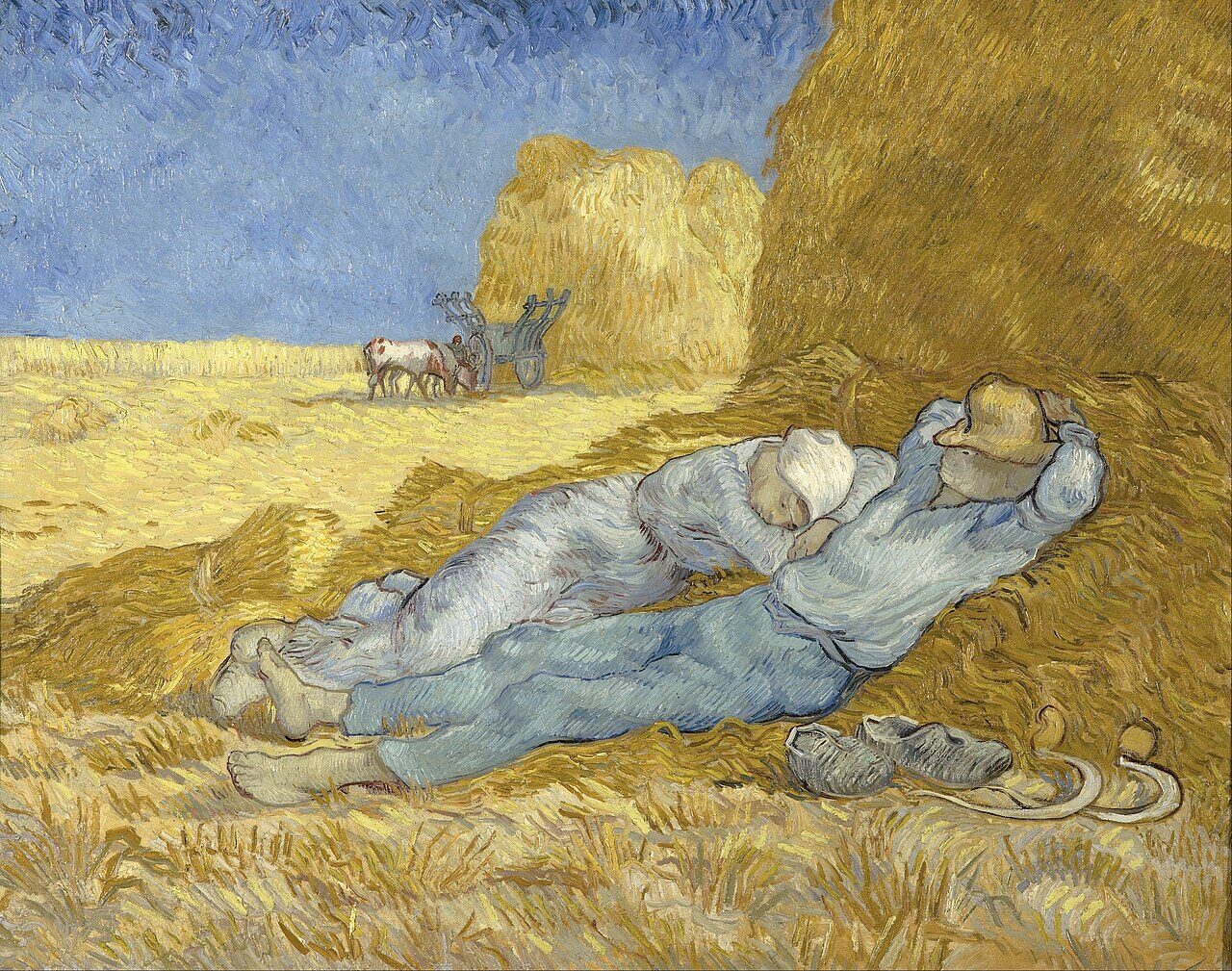
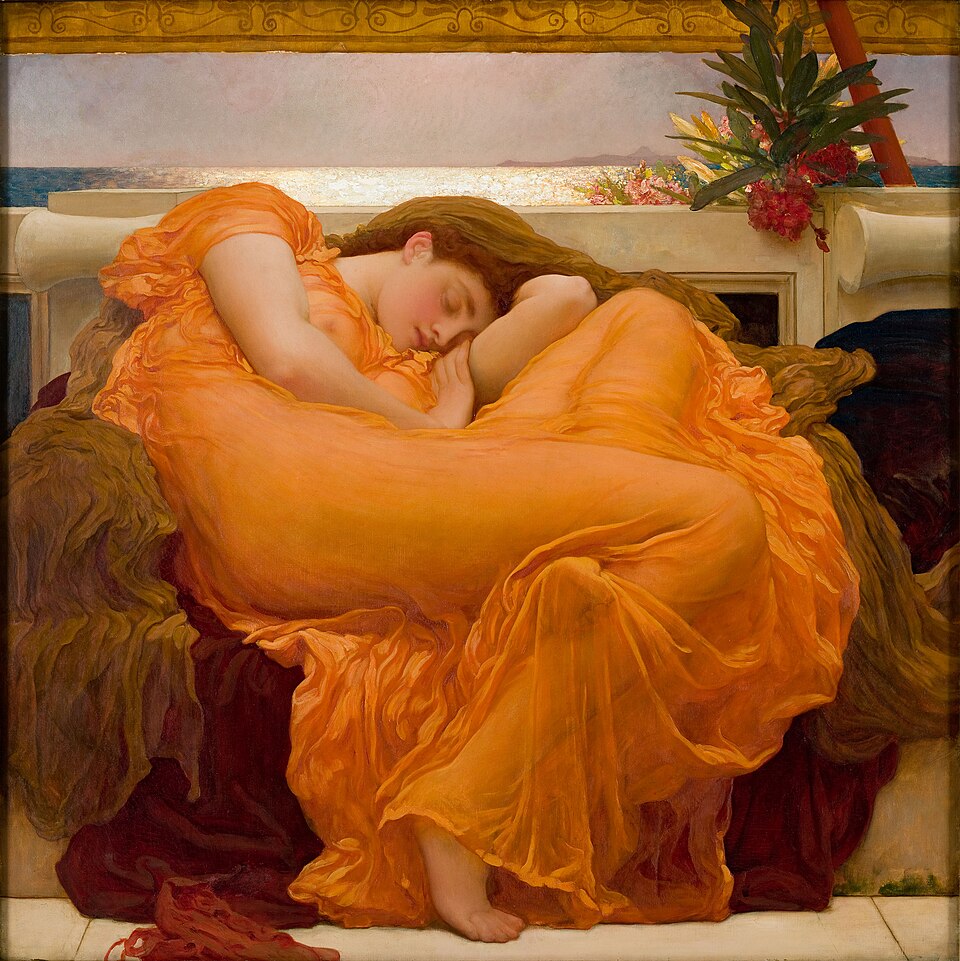
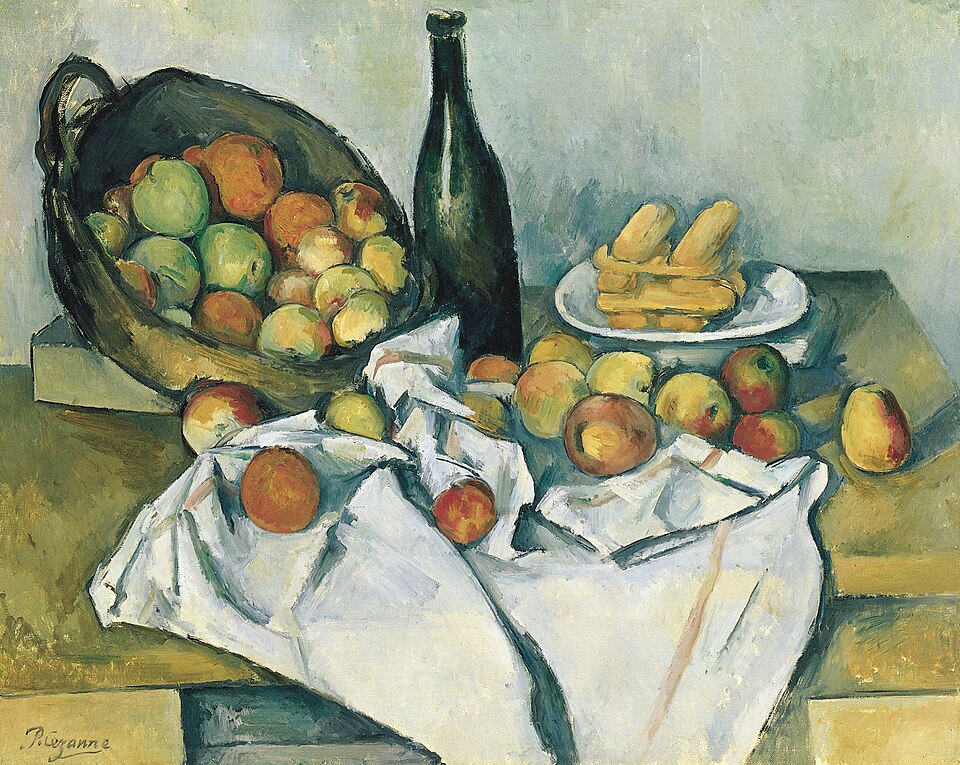
Créditos de imágenes: «La siesta» de Van Gogh, «Flaming June» de Frederic Leighton y «La cesta de manzanas» de Paul Cézanne; dominio público, vía Wikimedia Commons.
Image credits: "The Siesta" by Van Gogh, "Flaming June" by Frederic Leighton, and "The Basket of Apples" by Paul Cézanne; public domain, via Wikimedia Commons.