
Por NuzaBy Nuza
«La fascia es el órgano de la forma: lo que mantiene a cada parte en su lugar y, a la vez, conectada con todo lo demás.» Robert Schleip, investigador de fascia, Universidad de Ulm
"Fascia is the organ of form: what keeps each part in its place and, at the same time, connected to everything else." Robert Schleip, fascia researcher, University of Ulm
Dentro de ti hay una sola pieza de tejido que va de la planta de los pies hasta la cabeza, envolviéndolo todo. Eso explica por qué un dolor de cuello a veces empieza en un pie, o por qué pisar mal al caminar puede, con los años, ir torciéndote la espalda. Tu cuerpo no es un montón de partes sueltas: es una sola red.
Inside you there's a single piece of tissue that runs from the soles of your feet to your head, wrapping everything. That's why a neck pain sometimes starts in a foot, or why stepping wrong as you walk can, over the years, slowly twist your back. Your body isn't a pile of loose parts: it's a single web.
En este artículo vamos a ver qué es ese tejido —se llama fascia—, por qué todo en ti está conectado, y por qué algo tan simple como masajear la planta de tu pie puede cambiar cómo se siente tu espalda.
In this article we'll look at what that tissue is —it's called fascia—, why everything in you is connected, and why something as simple as massaging the sole of your foot can change how your back feels.
La telaraña que te sostieneThe web that holds you
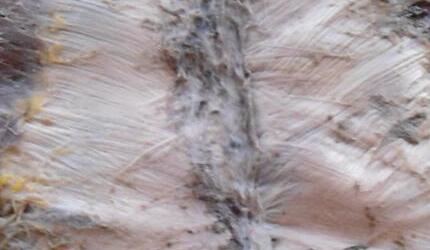
Debajo de la piel, envolviendo cada músculo, cada hueso y cada órgano, hay una red continua de tejido: la fascia. Imagina la telita blanca que ves cuando separas una pechuga de pollo — eso es fascia. En tu cuerpo es una sola pieza continua, de una sola tela, que va de la cabeza a los pies envolviéndolo todo y manteniéndolo en su lugar.
Beneath the skin, wrapping every muscle, every bone, and every organ, there's a continuous web of tissue: the fascia. Picture the thin white film you see when you pull apart a chicken breast — that's fascia. In your body it's a single continuous piece, of one cloth, that runs from head to feet wrapping everything and holding it in place.
Durante años se le ignoró: en las disecciones se cortaba y se tiraba para llegar a los músculos. Hoy la ciencia la considera uno de los grandes protagonistas del cuerpo. La doctora Helene Langevin —directora del centro de salud integrativa de los Institutos Nacionales de Salud de Estados Unidos— ha demostrado que la fascia está viva, llena de nervios, y que responde al movimiento y al estiramiento (Langevin, 2021).
For years it was ignored: in dissections it was cut away and thrown out to reach the muscles. Today science considers it one of the body's great protagonists. Dr. Helene Langevin —director of the center for integrative health at the National Institutes of Health in the United States— has shown that fascia is alive, full of nerves, and that it responds to movement and stretching (Langevin, 2021).
Todo está conectado: de los pies a la cabezaEverything is connected: from the feet to the head
Aquí viene lo importante. La fascia no envuelve cada músculo por separado y ya: forma líneas continuas que recorren todo el cuerpo, como cuerdas largas. El terapeuta Tom Myers las mapeó y les llamó vías anatómicas (Myers, Anatomy Trains, 2014).
Here's the important part. Fascia doesn't just wrap each muscle separately and stop there: it forms continuous lines that run through the whole body, like long ropes. The therapist Tom Myers mapped them and called them anatomy trains (Myers, Anatomy Trains, 2014).
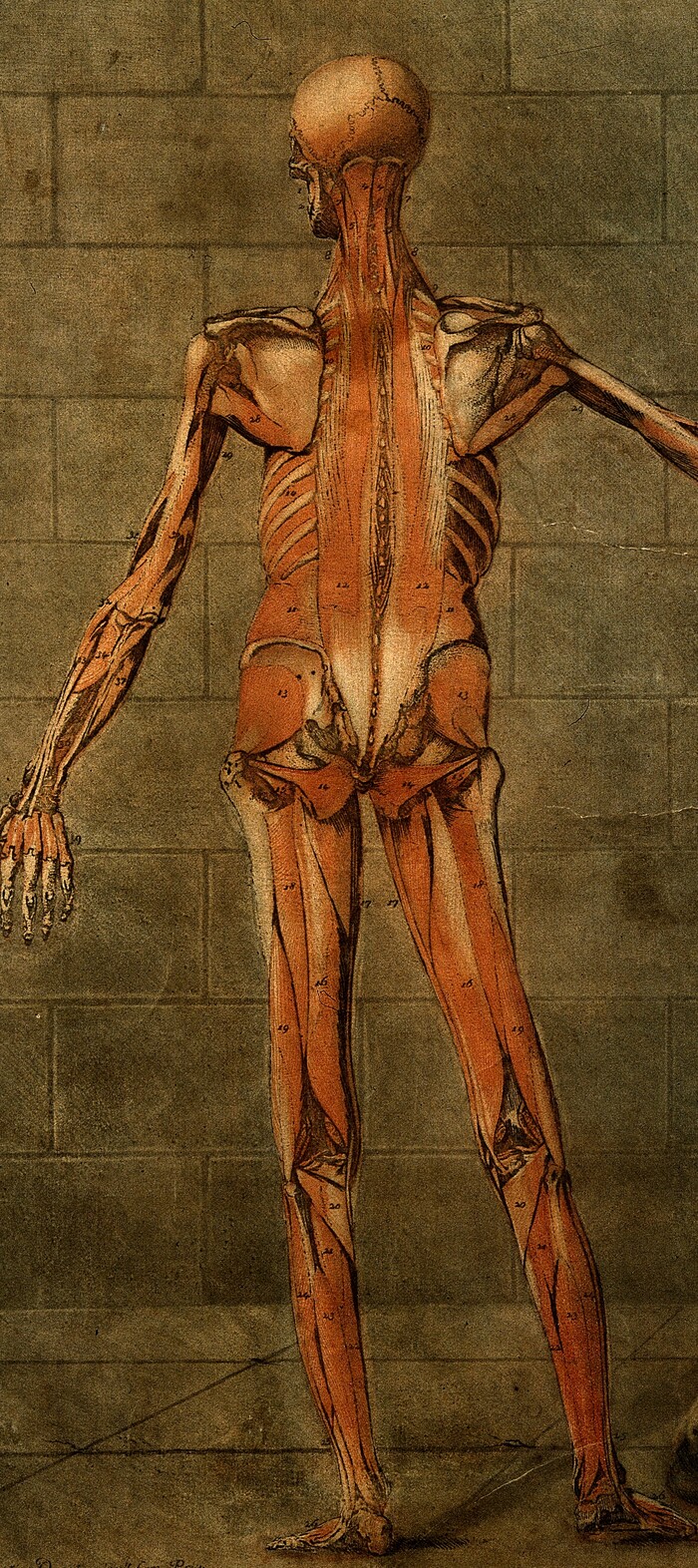
Una de esas líneas recorre toda la parte de atrás del cuerpo: empieza bajo la planta del pie, sube por el talón y la pantorrilla, sigue por la parte de atrás del muslo, por la espalda, y termina pasando por encima de la cabeza hasta la frente. Es una sola cuerda de tejido, de la planta del pie a las cejas.
One of those lines runs along the entire back of the body: it starts under the sole of the foot, climbs up the heel and the calf, continues up the back of the thigh, up the back, and ends by passing over the top of the head to the forehead. It's a single rope of tissue, from the sole of the foot to the eyebrows.
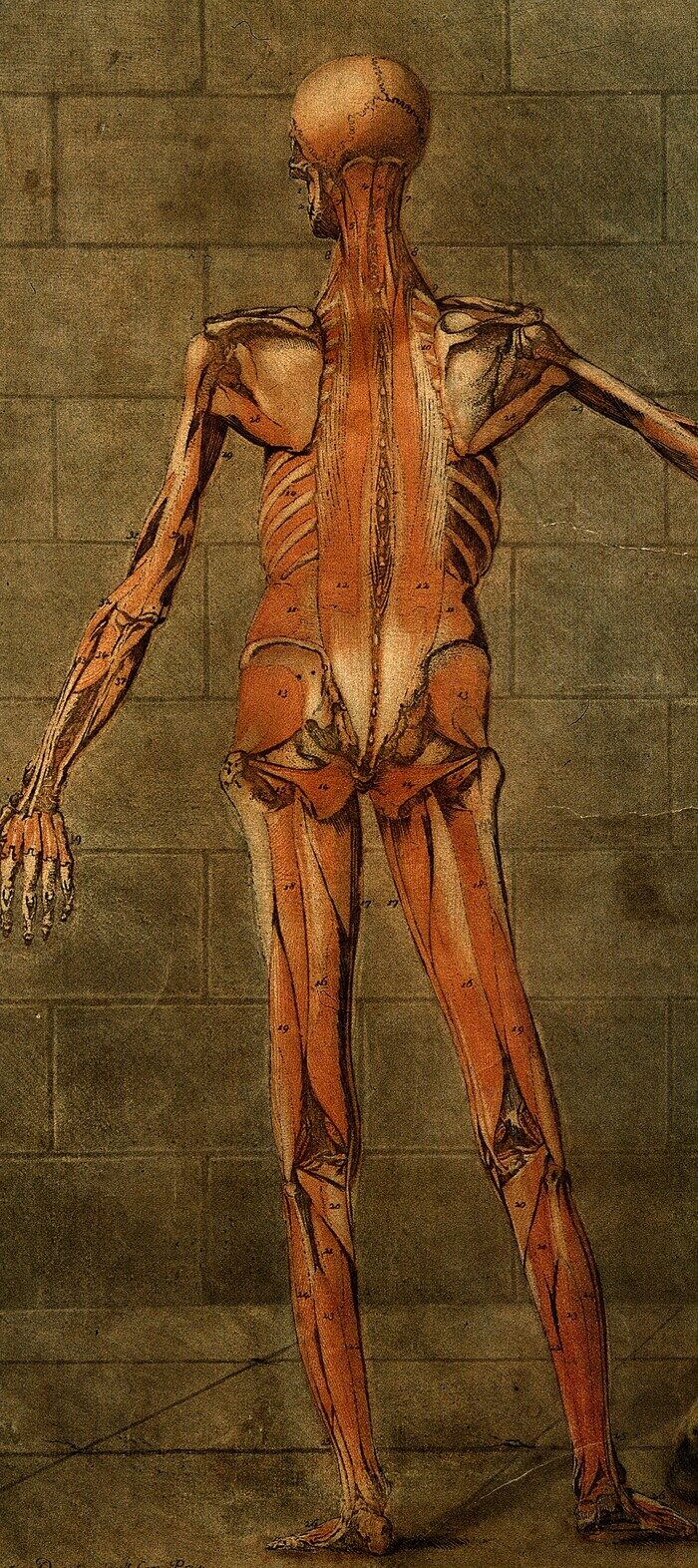
Por eso, cuando pisas mal, usas un zapato que te tuerce el pie, o pasas años cargando el peso de un solo lado, esa tensión no se queda ahí abajo: se transmite por toda la cuerda hacia arriba y, con el tiempo, te puede ir desalineando — un hombro más alto que el otro, la espalda que jala, el cuello tieso. Lo que pasa en el pie, se siente en la cabeza.
That's why, when you step wrong, wear a shoe that twists your foot, or spend years carrying weight on one side, that tension doesn't stay down there: it travels up the whole rope and, over time, can slowly throw you out of line — one shoulder higher than the other, a back that pulls, a stiff neck. What happens in the foot is felt in the head.
Por eso los pies importan tantoThat's why the feet matter so much
Si toda la línea de atrás empieza en la planta del pie, ese es el cimiento. Y aquí está la buena noticia, comprobada en estudios: trabajar la planta del pie afloja toda la cadena hacia arriba.
If the whole back line starts at the sole of the foot, that's the foundation. And here's the good news, proven in studies: working the sole of the foot loosens the entire chain above it.
En un experimento, personas rodaron la planta de su pie sobre una pelotita durante un par de minutos, y después podían agacharse más y tocarse más cerca de los pies — sin haber estirado las piernas ni la espalda, solo el pie (Wilke et al., 2019). Otro estudio encontró que masajear la planta mejora el equilibrio y el rendimiento de toda la parte de atrás del cuerpo (Grieve et al., 2022). Mover una sola pieza movió toda la cuerda.
In one experiment, people rolled the sole of their foot over a small ball for a couple of minutes, and afterward they could bend further and reach closer to their feet — without having stretched their legs or back at all, only the foot (Wilke et al., 2019). Another study found that massaging the sole improves balance and the performance of the whole back of the body (Grieve et al., 2022). Moving a single piece moved the entire rope.
Los nudos y por qué conviene automasajearseKnots, and why self-massage is worth it
Cuando un punto de la fascia se sobrecarga —por estrés, malas posturas, golpes, o de tanto repetir un movimiento— se vuelve denso y pegajoso, y ahí aparecen esos nudos que todos conocemos: zonas duras que duelen al tocarlas. Un nudo no solo molesta donde está; tira de toda la línea y reparte la tensión a distancia.
When a spot in the fascia gets overloaded —from stress, poor posture, blows, or from repeating a movement over and over— it becomes dense and sticky, and that's where those knots we all know appear: hard areas that hurt when you press them. A knot doesn't just bother you where it is; it pulls on the whole line and spreads the tension at a distance.
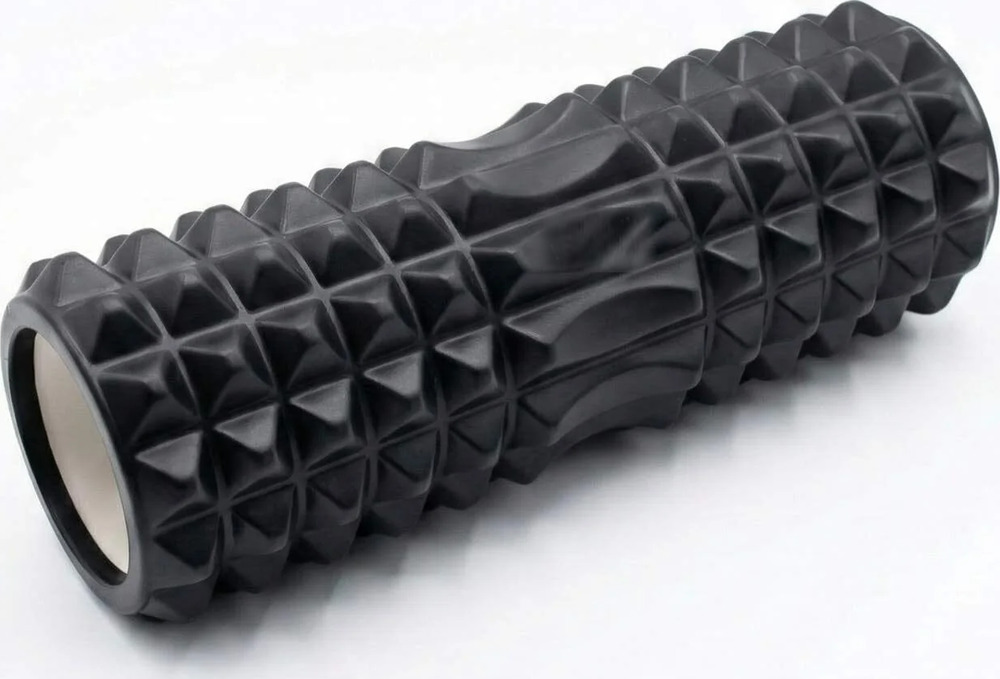
Por eso sirve tanto el automasaje. Rodar un rodillo (foam roller) o una pelotita sobre esas zonas, o un buen masaje descontracturante, le devuelven movilidad y deslizamiento a la fascia. Igual que estiras antes de moverte, vale la pena destrabar el tejido que sostiene todo.
That's why self-massage helps so much. Rolling a foam roller or a small ball over those areas, or a good deep massage, gives the fascia back its mobility and glide. Just as you stretch before you move, it's worth freeing up the tissue that holds everything together.
La fascia siente: somos pura sensaciónFascia feels: we are pure sensation
Aquí está lo que casi nadie sabe. La fascia no solo sostiene — también siente. Es uno de los tejidos con más terminaciones nerviosas de todo el cuerpo. Es la que te dice, sin que mires, dónde está tu mano o cómo estás parado; esa percepción se llama propiocepción (Schleip, 2021; Langevin, 2021).
Here's what almost no one knows. Fascia doesn't only hold — it also feels. It's one of the tissues with the most nerve endings in the whole body. It's what tells you, without looking, where your hand is or how you're standing; that perception is called proprioception (Schleip, 2021; Langevin, 2021).
Dicho de otra forma: la fascia es como un gran sentido repartido por todo el cuerpo. Cuando está sana y móvil, te sientes presente, ágil, conectado contigo. Cuando está densa y deshidratada, esa señal se enturbia: te sientes tieso, torpe, desconectado de tu propio cuerpo.
Put another way: fascia is like one big sense spread throughout the whole body. When it's healthy and mobile, you feel present, agile, connected to yourself. When it's dense and dehydrated, that signal gets cloudy: you feel stiff, clumsy, disconnected from your own body.
El agua lo cambia todoWater changes everything
Y aquí entra una palabra clave: hidratación. La fascia es en gran parte agua, y necesita estarlo para deslizarse y para transmitir bien sus señales. Una fascia hidratada se mueve como seda; una fascia seca se pega y se vuelve rígida (Schleip, 2021).
And here a key word comes in: hydration. Fascia is largely water, and it needs to stay that way to glide and to carry its signals well. Hydrated fascia moves like silk; dry fascia sticks and turns rigid (Schleip, 2021).
El agua no llega sola: la fascia se hidrata con movimiento. Cuando te mueves, estiras y te masajeas, exprimes y vuelves a empapar el tejido, como una esponja. Por eso quedarte quieto mucho tiempo te entumece, y moverte un poco te «despierta». Tomar agua ayuda, pero moverte es lo que de verdad la lleva adentro.
Water doesn't get there on its own: fascia hydrates through movement. When you move, stretch, and massage yourself, you wring out and re-soak the tissue, like a sponge. That's why staying still for a long time leaves you numb, and moving a little "wakes you up." Drinking water helps, but moving is what really carries it in.
Antenas de carneAntennas of flesh
Si la fascia es una red sensible que recorre todo el cuerpo, no es de extrañar que muchas tradiciones la hayan intuido como algo más que sostén: como el medio por el que nos «sintonizamos» con nosotros mismos y con lo que nos rodea. En esa mirada, somos como antenas — y cuanto más limpia y viva está la red, mejor recibimos la señal.
If fascia is a sensitive web running through the whole body, it's no surprise that many traditions have sensed it as more than support: as the medium through which we "tune in" to ourselves and to what surrounds us. In that view, we're like antennas — and the cleaner and more alive the web is, the better we receive the signal.
La ciencia aún no mide esa idea de la antena ni la conexión con la glándula pineal de la que hablan las tradiciones; eso pertenece, por ahora, al terreno de la experiencia y la contemplación. Pero lo que sí es cierto, y comprobado, es la base de todo: una fascia hidratada y móvil te hace sentir más, percibir mejor y habitar tu cuerpo con más claridad. Y desde ahí —desde un cuerpo que se siente— es desde donde cualquier conexión más profunda se vuelve posible.
Science doesn't yet measure that antenna idea or the connection with the pineal gland that the traditions speak of; that belongs, for now, to the realm of experience and contemplation. But what is true, and proven, is the foundation of it all: hydrated, mobile fascia makes you feel more, perceive better, and inhabit your body with more clarity. And from there —from a body that feels— is where any deeper connection becomes possible.
Para practicar hoyTo practice today
1. Despierta tus pies1. Wake up your feet
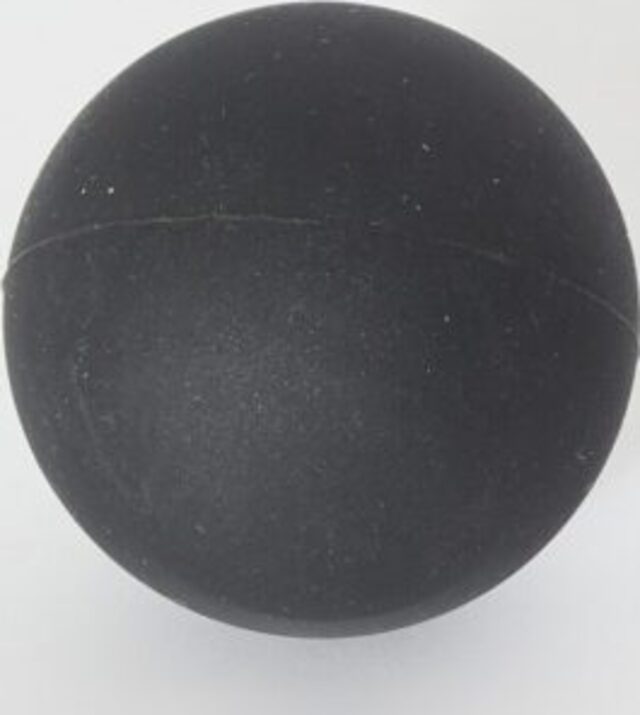
De pie, pon una pelotita (como las de la imagen anterior) bajo un pie y ródala despacio: el talón, el arco, la base de los dedos. Un par de minutos por pie, sin apretar hasta el dolor. Al terminar el primer pie, párate y nota la diferencia entre un lado y el otro: muchas veces sientes ese lado más largo y más apoyado.
Standing, place a small ball (like the ones in the image above) under one foot and roll it slowly: the heel, the arch, the base of the toes. A couple of minutes per foot, without pressing into pain. When you finish the first foot, stand up and notice the difference between one side and the other: often you feel that side longer and more grounded.
2. Rueda la línea de atrás2. Roll the back line
Con un rodillo, pasa lento por las pantorrillas, la parte de atrás de los muslos y la espalda alta. Donde encuentres un punto sensible, quédate ahí respirando hasta que afloje. Estás destrabando la misma cuerda que llega hasta tu cabeza.
With a roller, go slowly over the calves, the back of the thighs, and the upper back. Wherever you find a tender spot, stay there breathing until it lets go. You're freeing up the same rope that reaches all the way to your head.
3. Hidrata con movimiento3. Hydrate through movement
La fascia se hidrata moviéndote, no solo bebiendo agua. Si pasas horas sentado, levántate cada tanto y haz movimientos suaves y ondulantes —rodar la columna, mecer las caderas, estirarte como al despertar—. Pequeñas dosis, seguido, mantienen el tejido vivo.
Fascia hydrates by moving, not just by drinking water. If you spend hours sitting, get up every so often and do soft, wavelike movements —rolling the spine, rocking the hips, stretching the way you do when you wake up—. Small doses, often, keep the tissue alive.
Tu cuerpo es una sola pieza, tejida de pies a cabeza. Cuidar la fascia —moverla, hidratarla, destrabarla— es cuidar el hilo que lo conecta todo. Y entre más vivo está ese hilo, más te sientes en casa dentro de ti.
Your body is a single piece, woven from head to toe. Caring for the fascia —moving it, hydrating it, freeing it up— is caring for the thread that connects everything. And the more alive that thread is, the more you feel at home inside yourself.
ReferenciasReferences
- Langevin, H. M. (2021). Fascia mobility, proprioception, and myofascial pain. Life, 11(7), 668. (Directora del National Center for Complementary and Integrative Health, NIH.)(Director of the National Center for Complementary and Integrative Health, NIH.)
- Schleip, R. (2021). Investigaciones sobre las propiedades biomecánicas y sensoriales de la fascia. Universidad de Ulm. (Sobre la fascia como órgano sensorial y la importancia de la hidratación.)Research on the biomechanical and sensory properties of fascia. University of Ulm. (On fascia as a sensory organ and the importance of hydration.)
- Myers, T. W. (2014). Anatomy Trains: Myofascial Meridians for Manual and Movement Therapists (3.ª ed.). Elsevier. (Las líneas miofasciales, incluida la Línea Posterior Superficial.)(3rd ed.). Elsevier. (The myofascial lines, including the Superficial Back Line.)
- Wilke, J. et al. (2019). Self-myofascial release of the superficial back line improves sit-and-reach distance. Journal of Sports Science & Medicine, 18(1), 87–94.
- Grieve, R. et al. (2022). Myofascial treatment techniques on the plantar surface influence functional performance in the dorsal kinetic chain. Journal of Bodywork and Movement Therapies.
- Stecco, C. (2015). Functional Atlas of the Human Fascial System. Elsevier. (Anatomía de la fascia.)(Anatomy of the fascia.)
Créditos de imágenes: Rodillo de espuma y pelotitas con púas: vía Wikimedia Commons (CC BY-SA 4.0). Pelotita lisa: vía Wikimedia Commons (CC0). La ilustración de la línea de fascia es propia.
Image credits: Foam roller and spiked balls: via Wikimedia Commons (CC BY-SA 4.0). Smooth ball: via Wikimedia Commons (CC0). The fascia line illustration is our own.