
Por NuzaBy Nuza
«El prāṇa es la energía que impregna el universo en todos sus niveles.»"Prāṇa is the energy that permeates the universe at every level." B. K. S. Iyengar, Luz sobre el prāṇāyāmaLight on Prāṇāyāma
Si los chakras son los centros de energía, los nadis son los caminos que los conectan: la red de canales por los que, según el yoga, fluye el prāṇa —tu energía vital— por todo el cuerpo. No se ven en una radiografía, pero llevamos siglos trabajándolos en cada respiración consciente.
If the chakras are the energy centers, the nadis are the paths that connect them: the network of channels through which, according to yoga, prāṇa —your vital energy— flows throughout the body. They don't show up on an X-ray, but we've been working them for centuries with every conscious breath.
En este artículo vamos a ver qué son los nadis, cuáles son los tres principales, por qué tienen tanto que ver con tu manera de respirar, y cómo el yoga los usa para devolverte el equilibrio.
In this article we'll look at what the nadis are, which are the three main ones, why they have so much to do with the way you breathe, and how yoga uses them to bring you back to balance.
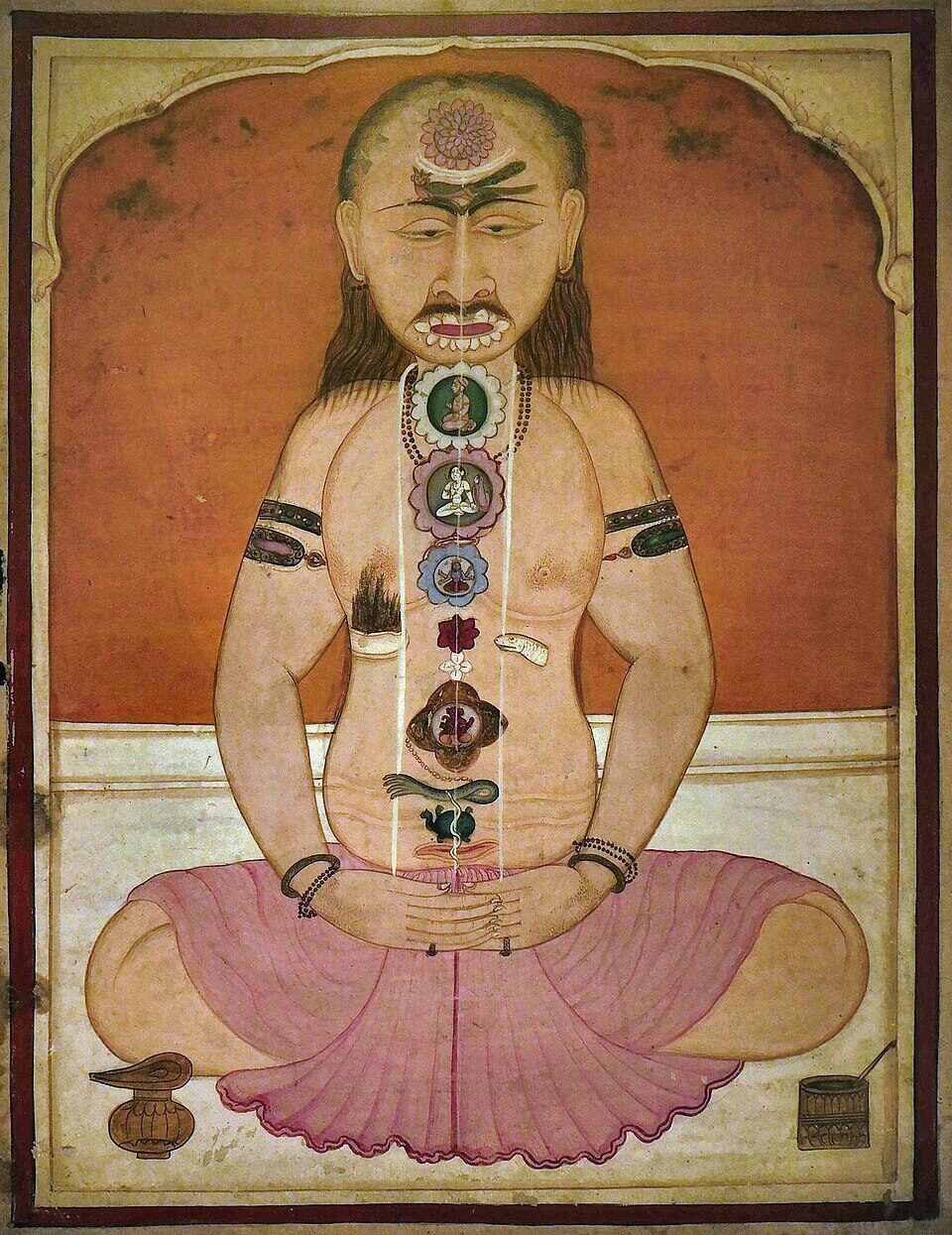
Qué son los nadisWhat the nadis are
La palabra nadi significa «río», «cauce» o «corriente». Y eso es justo lo que describe: los canales por donde corre tu energía. El yoga no mira el cuerpo solo como huesos y músculos, sino también como un cuerpo sutil —el mismo mapa al que pertenecen los chakras— recorrido por miles de estos hilos.
The word nadi means "river," "channel," or "current." And that's exactly what it describes: the channels your energy runs through. Yoga doesn't see the body only as bones and muscles, but also as a subtle body —the same map the chakras belong to— threaded by thousands of these strands.
Los textos clásicos, como la Haṭha Yoga Pradīpikā y el Gheraṇḍa Saṁhitā, hablan de 72.000 nadis tejidos por todo el cuerpo. No son venas ni nervios que puedas diseccionar: son los cauces por donde, según esta tradición, fluye el prāṇa. La imagen es sencilla y útil: cuando los ríos corren limpios, la energía se mueve y te sientes vivo y claro; cuando se atascan, aparece la pesadez, el estancamiento, esa sensación de no fluir.
The classical texts, like the Haṭha Yoga Pradīpikā and the Gheraṇḍa Saṁhitā, speak of 72,000 nadis woven throughout the body. They aren't veins or nerves you can dissect: they're the channels through which, according to this tradition, prāṇa flows. The image is simple and useful: when the rivers run clean, the energy moves and you feel alive and clear; when they get blocked, heaviness shows up, stagnation, that sense of not flowing.
Los tres principalesThe three main ones
De esos miles de canales, tres son los principales —los que más se trabajan en el yoga—, y los tres recorren la columna de abajo hacia arriba.
Of those thousands of channels, three are the main ones —the ones most worked with in yoga— and all three run up the spine from the bottom.
Ida — el canal lunarIda — the lunar channel
Sube por el lado izquierdo y termina en la fosa nasal izquierda. Es la energía lunar: fresca, receptiva, hacia dentro. La parte de ti que descansa, siente y se recoge. Cuando Ida fluye bien, hay calma y serenidad.
It rises up the left side and ends at the left nostril. It's the lunar energy: cool, receptive, inward. The part of you that rests, feels, and gathers itself. When Ida flows well, there's calm and serenity.
Pingala — el canal solarPingala — the solar channel
Sube por el lado derecho y termina en la fosa nasal derecha. Es la energía solar: cálida, activa, hacia fuera. La parte de ti que actúa, decide y hace. Cuando Pingala fluye bien, hay vitalidad y empuje.
It rises up the right side and ends at the right nostril. It's the solar energy: warm, active, outward. The part of you that acts, decides, and gets things done. When Pingala flows well, there's vitality and drive.
Sushumna — el canal centralSushumna — the central channel
Es el más importante. Corre recto por el centro de la columna, de la base a la coronilla, y es el eje por donde se ensartan los siete chakras. Por aquí, cuando las condiciones están dadas, la energía puede ascender hacia la consciencia. Normalmente Sushumna está «dormido»; todo el trabajo del yoga apunta a equilibrar Ida y Pingala para que la energía pueda entrar en él.
It's the most important one. It runs straight up the center of the spine, from the base to the crown, and it's the axis the seven chakras are strung along. Through here, when the conditions are right, energy can rise toward consciousness. Sushumna is usually "asleep"; all the work of yoga aims to balance Ida and Pingala so the energy can enter it.
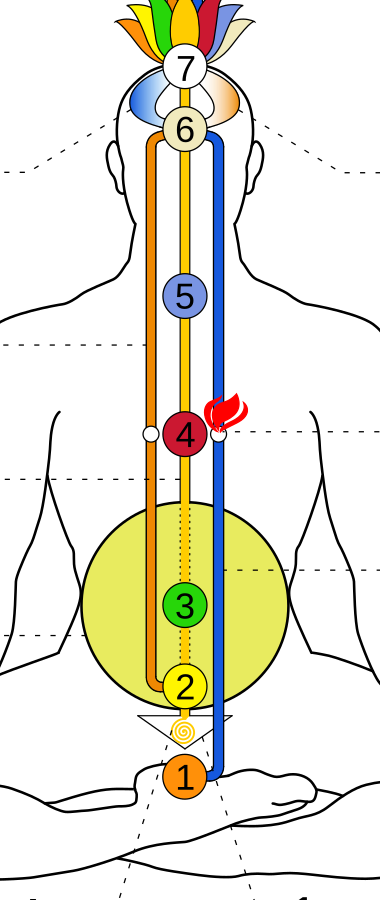
Ida y Pingala no van rectos: suben enroscándose alrededor de Sushumna y se cruzan a la altura de cada chakra. Si esa imagen te suena conocida es porque lo es: es casi idéntica al caduceo —dos serpientes que trepan en espiral por un bastón central—, un símbolo que aparece en culturas muy distintas para hablar de lo mismo, la energía vital subiendo por el eje del cuerpo.
Ida and Pingala don't run straight: they rise winding around Sushumna and cross at the level of each chakra. If that image feels familiar, that's because it is: it's almost identical to the caduceus —two snakes spiraling up a central staff— a symbol that appears in very different cultures to talk about the same thing, vital energy rising up the axis of the body.

Ida y Pingala: dos polos que buscan equilibrioIda and Pingala: two poles looking for balance
Toda la idea se sostiene en un par de opuestos que el cuerpo está siempre intentando balancear: sol y luna, hacer y descansar, calentar y enfriar. Cuando Pingala domina demasiado, te sientes acelerado, inquieto, encendido de más; cuando domina Ida, llega la pesadez, el bajón, la niebla. Para esta tradición, estar bien es justo eso: que los dos estén en equilibrio.
The whole idea rests on a pair of opposites the body is always trying to balance: sun and moon, doing and resting, warming and cooling. When Pingala dominates too much, you feel sped up, restless, overheated; when Ida dominates, heaviness sets in, the slump, the fog. For this tradition, being well is exactly that: the two of them in balance.
Y aquí pasa algo curioso: a lo largo del día respiras más por una fosa nasal que por la otra, alternándose en un ritmo de varias horas. La ciencia lo llama el ciclo nasal; el yoga leyó ese mismo vaivén como Ida y Pingala turnándose el protagonismo. El mismo fenómeno, dos lenguajes distintos.
And here's something curious: throughout the day you breathe more through one nostril than the other, alternating in a rhythm of several hours. Science calls it the nasal cycle; yoga read that same back-and-forth as Ida and Pingala taking turns at the lead. The same phenomenon, two different languages.
Por eso respiramos por fosas alternasThis is why we breathe through alternate nostrils
Si los nadis se equilibran a través de la respiración, tiene todo el sentido que exista una técnica para ello — y la hay. Se llama nadi shodhana, que significa literalmente «limpieza de los nadis»: la respiración por fosas nasales alternas.
If the nadis balance through the breath, it makes perfect sense that there's a technique for it — and there is. It's called nadi shodhana, which literally means "cleansing of the nadis": alternate nostril breathing.
Nadi shodhana, paso a pasoNadi shodhana, step by step
Siéntate cómodo. Con el pulgar derecho tapa la fosa nasal derecha e inhala despacio por la izquierda. Tapa la izquierda con los dedos, destapa la derecha y exhala por ella. Inhala por la derecha, cambia, y exhala por la izquierda. Eso es un ciclo. Un buen punto de partida son unos cuatro segundos al inhalar y cuatro al exhalar, alargando poco a poco la exhalación a medida que te sientas cómodo. Haz unos cuantos ciclos, sin forzar, dejando que la respiración se alargue sola. En pocos minutos la mente se asienta y la respiración se empareja: es de las formas más simples y fiables de volver al centro.
Sit comfortably. With your right thumb close the right nostril and inhale slowly through the left. Close the left with your fingers, open the right, and exhale through it. Inhale through the right, switch, and exhale through the left. That's one cycle. A good starting point is about four seconds on the inhale and four on the exhale, gradually lengthening the exhale as you feel comfortable. Do a few cycles, without forcing, letting the breath stretch out on its own. Within a few minutes the mind settles and the breath evens out: it's one of the simplest and most reliable ways to come back to center.
Como vimos en el artículo sobre la respiración y el sistema nervioso, el aliento es la puerta que sí podemos abrir a voluntad para influir en todo lo demás.
As we saw in the article on the breath and the nervous system, the breath is the door we can actually open at will to influence everything else.
La conexión con los chakrasThe connection with the chakras
Aquí se cierra el círculo. Sushumna, el canal central, es el mismo eje a lo largo del cual se alinean los siete chakras. Cuando Ida y Pingala se equilibran, la energía deja de quedarse atrapada en los costados y puede subir por Sushumna, atravesando los chakras hacia la coronilla. Eso —el ascenso de la energía por el eje del cuerpo— es, en el fondo, hacia donde apunta toda la práctica.
Here the circle closes. Sushumna, the central channel, is the same axis the seven chakras line up along. When Ida and Pingala come into balance, the energy stops getting trapped on the sides and can rise up Sushumna, passing through the chakras toward the crown. That —the rising of energy up the axis of the body— is, at its core, what the whole practice is pointing toward.
Al final, los nadis enseñan algo muy simple: que el sol y la luna que llevas dentro —lo que te activa y lo que te calma— buscan estar en equilibrio, y que tienes una herramienta para ayudarlos siempre a la mano. El centro nunca se pierde del todo; se recupera, inhalando y exhalando.
In the end, the nadis teach something very simple: that the sun and the moon you carry inside —what activates you and what calms you— want to be in balance, and that you always have a tool to help them right at hand. The center is never lost for good; it comes back, with an inhale and an exhale.
ReferenciasReferences
- Saraswati, Swami Satyananda (1996). Kuṇḍalinī Tantra. Bihar School of Yoga. (Descripción tradicional de los nadis y de nadi shodhana.)
- Saraswati, Swami Satyananda (1996). Asana Pranayama Mudra Bandha. Bihar School of Yoga.
- Svātmārāma. Haṭha Yoga Pradīpikā, cap. 2. (Texto del siglo XV sobre prāṇāyāma y la purificación de los nadis.)
- Avalon, Arthur (Sir John Woodroffe) (1919). The Serpent Power. (Fuente clásica en inglés sobre el cuerpo sutil, los nadis y los chakras.)
- Mallinson, J. y Singleton, M. (2017). Roots of Yoga. Penguin Classics. (Contexto histórico del cuerpo sutil.)
Créditos de imágenes: yogui en meditación (noroeste de la India, s. XIX) y caduceo, dominio público; diagrama de los tres canales, vía Wikimedia Commons (CC BY-SA).
Image credits: yogi in meditation (northwest India, 19th c.) and caduceus, public domain; diagram of the three channels, via Wikimedia Commons (CC BY-SA).